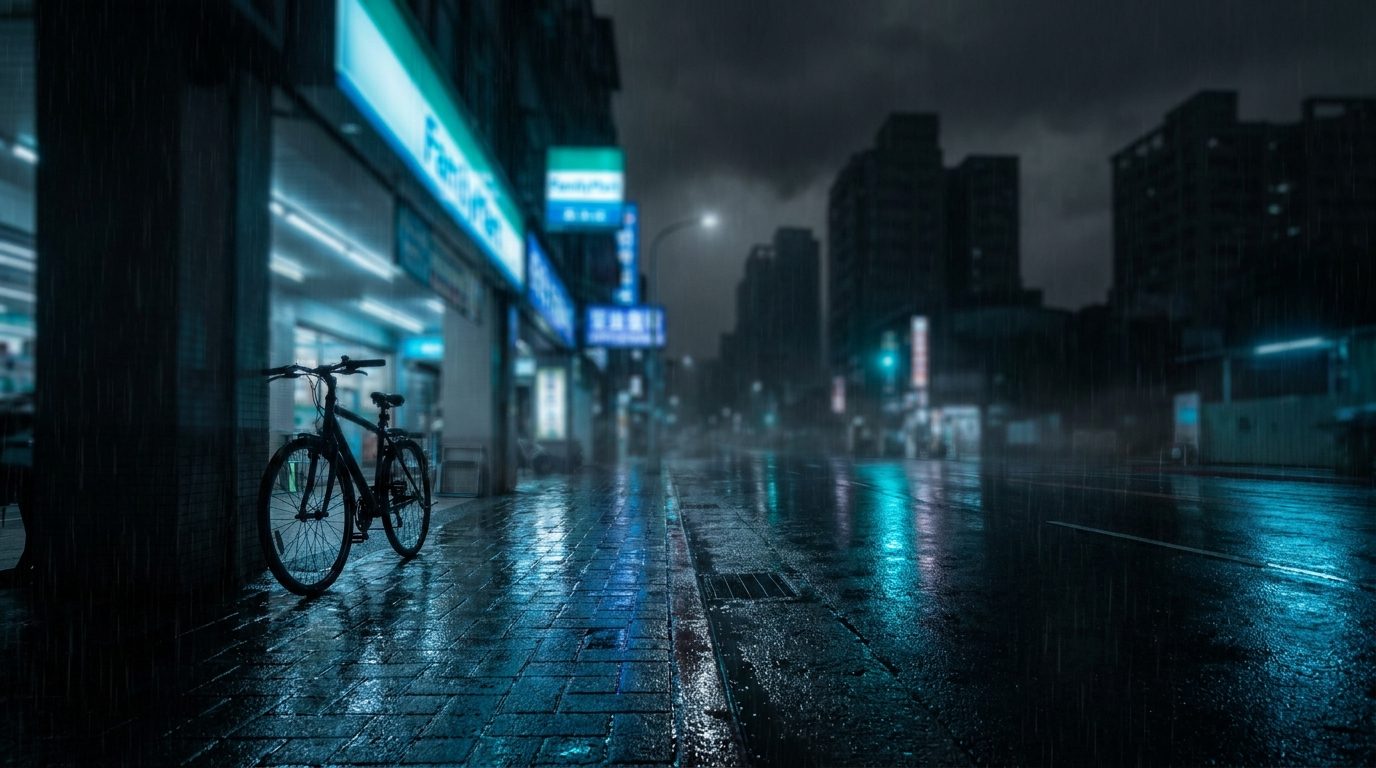
Night riding Taipei: the city as an interface
Jun 2, 2026 · ≈ 11 min read
Two in the morning, riding a YouBike through Xinyi District. Taipei by day and Taipei by night are two entirely different cities. Daytime Taipei is functional — traffic, work, consumption. Nighttime Taipei is interfacial — lights, signals, flows of information.
0x01 Xinyi District
The lights of Taipei 101 are already off, but the surrounding neon is still on. The white fluorescent tubes of the 24-hour convenience stores look like individual pixels in the deep night. Every 7-Eleven is a micro node of the city — you can withdraw money, ship a package, buy coffee, or just sit and space out there. Together they form a distributed urban network with nodes spaced about five minutes apart on foot.
From a design perspective, Taipei's convenience store layout is a perfect coverage grid. No map needed, no navigation. You only need to know one thing: walk along any arterial road and you'll hit one within five minutes. It's a UI that doesn't depend on a screen.
0x02 Streetlights as navigation
I have an informal classification of Taipei's night navigation system:
- Cool-white LED streetlights = arterial roads. Cold-toned, high brightness, lighting the pavement like an operating table. They say: "Keep going, don't stop."
- Warm-yellow streetlights = alleys. Dimmer, warmer, the edges of the light blurred. They say: "You've arrived. Slow down."
- No lights at all = private property or a dead end. Don't ride in.
This system requires no electronic device of any kind. It's a byproduct of decades of urban planning. But once you notice it, you can never unsee it again. It becomes an invisible API.
0x03 The sound layer
Taipei by day is loud — scooter engines, street vendors, the hum of air conditioner compressors. By two in the morning those sounds are gone, replaced by another soundscape:
- The occasional distant scooter (quieter than you'd think)
- The automatic doors of convenience stores opening and closing (a single "ding-dong")
- Your own breathing and the sound of the bicycle chain (louder than you'd imagine)
- Certain basement vents at certain corners, humming at low frequency (those are server rooms)
By day these sounds are drowned out. At night they become navigation signals — without looking at any map you can tell how far you are from an artery, whether some facility nearby is still running.
0x04 The city as an interface
We're used to understanding cities through screens — Google Maps, Uber Eats, Foodpanda. But the screen is only a narrow-band interface to the city. The real urban interface is physical: the texture of pavement, the color temperature of light, the humidity of air, the reflection of sound.
Riding through Taipei at two in the morning is practice in turning off the screen and switching on your other senses. No destination, no schedule. Just moving through the city, feeling for the signals that daytime noise buries.
If you're in Taipei too, try going out for a walk some night. Leave your phone behind. You'll find this city has another interface — and it's been there all along.
What does your city look like at night? Write to ryu@scolv.com.